Table of Contents
- What Separates Heavy-Door Hardware Brands in 2026
- Quick Comparison: Top Heavy-Door Door Hardware Picks
- Grade 1 Commercial Door Hardware: The Baseline for Renovation Specs
- Commercial Door Closers Built for High-Traffic Buildings
- Fire-Rated Door Hardware Requirements for Renovation Projects
- How to Build a Commercial Door Hardware Schedule
- Total Cost of Ownership and Retrofit Planning
- Conclusion: Choosing the Right Hardware Partner
- Frequently Asked Questions
Last Updated: October 14, 2026
What Separates Heavy-Door Hardware Brands in 2026
Ask ten contractors what makes heavy-duty door hardware reliable and you'll get ten answers, most of them wrong. The real answer is simpler: grade ratings, cycle testing, and how honest the manufacturer is about both.
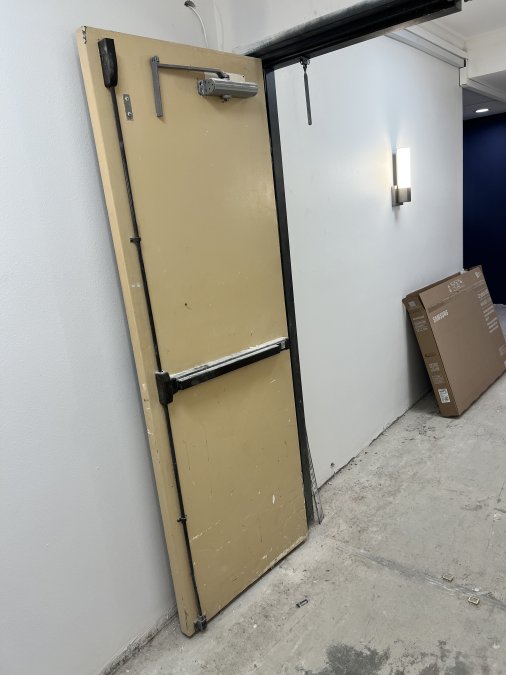
The brands worth your money share three traits: they publish their ANSI grade, they build from materials that match the application, and they stand behind the product with real warranty coverage.
Quick Comparison: Top Heavy-Door Door Hardware Picks
Most commercial hardware roundups compare products inside a single category, closers against closers, exit devices against exit devices. That approach breaks down during a renovation, because a door opening is a system.
The table below compares hardware across categories so you can see how a complete opening comes together. Every item is Grade 1, which is the baseline for commercial renovation work.
| Product | Category | Best For |
|---|---|---|
| 900PBF Series Door Closer | Door closer | High-traffic entrances |
| Genesis CGN Series Lockset | Cylindrical lock | Offices, schools, hospitals |
| A6600 Series Rim Exit Device | Exit device | Fire exit doors |
| A9820EO 48" ADA Exit Device | Panic bar | ADA-compliant egress |
| BB5200 Heavy Weight Hinge | Hinge | Heavy doors, corridors |
| CB160 Heavy Duty Deadbolt | Deadbolt | Maximum security doors |
How to Compare Brands Across Categories
A brand that makes an excellent closer may not make an equally strong hinge. When you evaluate a manufacturer for a renovation, compare them category by category using the same criteria:

- Published ANSI/BHMA grade. Grade 1 is the minimum for high-traffic commercial openings. If the grade is not published, treat the product as unrated.
- Cycle rating. The grade label tells you the classification; the cycle rating tells you how the product earned it. Ask for both.
- Material and finish. Stainless steel and solid brass hold up better than plated substrates in high-use openings. Finish warranties vary, so check what is covered and for how long.
- Fire and egress listings. For fire-rated or means-of-egress openings, verify UL listings and compliance with accessibility requirements in writing.
- Warranty terms. A limited lifetime warranty is only useful if the exclusions do not swallow the coverage. Read the fine print before you standardize on a brand.
Why Cross-Category Comparison Matters
A common pattern in renovation specifications is a Grade 1 closer paired with a Grade 3 hinge. The hinge fails first, and the opening that should have lasted a decade needs service within a year. Comparing brands across every category on the schedule, not just the category you happen to be shopping for, is the fastest way to avoid that outcome.
Grade 1 Commercial Door Hardware: The Baseline for Renovation Specs
Grade 1 is the highest durability classification in the ANSI/BHMA system, and it's the only grade we recommend for commercial renovation work.
What does Grade 1 actually mean in practice? It means the hardware survived cycle testing at volumes that reflect years of daily use. A Grade 1 cylindrical lock like our Genesis CGN Series Lockset meets or exceeds BHMA/ANSI A156.2 Series 4000 requirements.

Three things to verify on any Grade 1 spec sheet:
- The specific ANSI standard it's tested against (A156.2 for locks, A156.4 for closers, A156.3 for exit devices)
- The cycle rating, not just the grade label
- Whether it's UL listed for fire door assemblies if the opening requires it
Commercial Door Closers Built for High-Traffic Buildings
Door closers take more abuse than any other piece of hardware on a commercial door.
Our 900PBF Series Door Closer is built specifically for office buildings, shopping centers, and other commercial spaces where the door never stops moving.
Key features that matter for renovation projects:
- Universal application with non-handed mounting for standard, top jamb, or parallel arm installation
- Adjustable closing and latching speed via two separate valves
- Six attaching holes for secure mounting to door or frame
- Optional delayed action, factory preset for approximately 20 seconds, adjustable up to one minute
- Barrier Free (BF) option meeting ADA regulation for easier opening
The delayed action option is worth calling out for renovation work. It's designed for handicapped or elderly users who need extra time to pass through the doorway, and it's adjustable on site.
Fire-Rated Door Hardware Requirements for Renovation Projects
Fire-rated openings have their own rules, and they're stricter than most renovation crews expect.
The A6600 Series Rim Exit Device is UL listed for fire exit hardware for up to 3-hour fire-rated installations. It's available in rim and surface vertical rod designs, both non-handed and easily reversible.

If you're specifying hardware for a fire-rated opening, verify these three things in writing:
- UL listing for fire door assemblies, not just panic hardware
- The fire rating in hours the assembly supports
- Whether thru-bolts are included (they're standard on fire-rated devices for a reason)
The CON88 Heavy Duty Concealed Overhead Stop Holder is another component worth considering for fire-rated openings.
How to Build a Commercial Door Hardware Schedule
A commercial door hardware schedule is a written specification listing every piece of hardware required for each door opening in a building. It's the document your contractor bids from, and it's the difference between a renovation that runs on schedule and one that stalls waiting for parts.
Building a hardware schedule comes down to six steps:
- Walk every opening and record the door type. Note whether it's a single or double door, wood or hollow metal, and its thickness.
- Assign a function to each opening. Is it a main entrance, a fire exit, a storage room, or a restroom? Function drives hardware selection.
- List required components per opening. Hinges, lockset or exit device, closer, stops, and door bottoms if the opening needs sealing.
- Match every component to the same ANSI grade. Grade 1 throughout, or the weak link fails first.
- Flag fire-rated and ADA openings separately. These need specific hardware and cannot be substituted.
- Verify lead times before finalizing. A schedule is only useful if the parts arrive when the crew needs them.
Total Cost of Ownership and Retrofit Planning
The cheapest hardware up front is almost never the cheapest over the life of the building. A Grade 3 lock that costs half as much as a Grade 1 unit and fails in two years costs more in labor, downtime, and replacement than the Grade 1 unit would have cost in the first place. Most practitioners find that product cost is a small fraction of the total cost of ownership on a commercial opening; the larger share is labor, downtime, and rework.
Lifecycle Cost Factors
When you compare hardware for a renovation, look beyond the purchase order:
- Installation labor. Hardware that requires frame modification, adapters, or drop plates adds labor hours and can delay the schedule.
- Maintenance and adjustment. Closers need valve adjustment; exit devices need periodic inspection. Products with accessible adjustment points reduce service calls.
- Replacement cycles. Grade 1 hardware is tested to cycle volumes that reflect years of daily use. Grade 3 hardware in the same opening may need replacement within a year or two.
- Warranty coverage. A limited lifetime warranty can offset replacement cost, but only if the failure mode is covered. Read the exclusions before you standardize.
- Downtime. A failed exit device on a means-of-egress opening can force the opening out of service until it is repaired. That cost rarely appears in the hardware budget but shows up in operations.
Retrofit Planning: Measure Before You Order
Retrofit planning is where renovation budgets quietly blow up. Existing openings rarely match modern hardware dimensions, and mismatches force adapters, drop plates, and sometimes full frame work.
Our Genesis CGN Series Lockset handles door ranges from 1 3/8" to 1 3/4" thickness standard, with 2" to 2 1/4" available on request, which covers most retrofit scenarios without modification.
For hinges, the BB5200 Heavy Weight Hinge is a 4-ball bearing, full mortise unit built for average to high-frequency use.
The CB160 Heavy Duty Deadbolt rounds out a security-focused opening with a 1" throw deadbolt and hardened steel insert that resists sawing and forced entry.
Compatibility Checklist for Renovation Openings
Before you finalize a hardware schedule, verify these items against the existing opening:
- Door thickness and material (wood, hollow metal, or other)
- Backset and existing prep (cross-bore, edge-bore, and mortise dimensions)
- Handing (left hand, right hand, or non-handed)
- Frame condition and whether reinforcement is needed
- Fire rating and UL listing requirements
- Accessibility requirements for the opening
Conclusion: Choosing the Right Hardware Partner
Every commercial renovation runs into the same wall eventually: the hardware spec looks right on paper, but the supplier can't deliver on time, or the product doesn't hold up, or the warranty turns out to be worthless.
At Cal Royal Hardware, we supply a comprehensive range of architectural hardware engineered for heavy-duty commercial and residential use, with fast distribution and a focus on products that install cleanly and last.
Search our store to find the heavy-duty door hardware your renovation needs, and get the grade rating, cycle data, and warranty terms in writing before you commit.
Frequently Asked Questions
What are the best commercial door hardware brands for a renovation?
The best brands for a commercial renovation are those that offer Grade 1 certified heavy-duty door hardware across multiple categories. Look for brands that provide ANSI/BHMA certified products, including door closers, locksets, exit devices, and hinges. Cal Royal Hardware offers a range of Grade 1 options like the 900PBF Series Door Closer and Genesis CGN Series Lockset, both designed for high-traffic commercial environments. Focus on brands with verifiable certifications, strong warranties, and product availability that matches your project timeline.
Which door hardware brands make heavy-duty commercial locks?
Brands that manufacture heavy-duty commercial locks typically offer Grade 1 cylindrical locksets and deadbolts tested to ANSI/BHMA standards. The Cal Royal CB160 Heavy Duty Deadbolt features a 1-inch throw with a hardened steel insert and meets ANSI/BHMA Grade 1 requirements. The Genesis CGN Series Lockset also meets or exceeds BHMA/ANSI A156.2 Series 4000 Grade 1 requirements. When evaluating heavy-duty commercial locks, check for solid brass or steel construction, anti-pick features, and compatibility with interchangeable cores for keying flexibility.
What should I look for in commercial door hardware for a renovation?
For a commercial renovation, prioritize Grade 1 certifications, material durability, and compatibility with existing door preparations. Check that hardware meets ANSI/BHMA standards for cycle testing and finish durability. Consider whether the hardware supports ADA compliance, especially for door closers and exit devices. Also evaluate the availability of templates and installation instructions, since renovation timelines depend on smooth installation. Cal Royal Hardware provides downloadable templates and installation guides for products like the 900PBF Series Door Closer, which helps contractors plan installations accurately.
How do I create a commercial door hardware schedule?
A commercial door hardware schedule lists every door opening in the project with its required hardware components: hinges, locksets, closers, exit devices, and stops. Start by identifying each door's function, fire rating, and traffic level. Then match hardware to those requirements using Grade 1 products for high-traffic or fire-rated openings. Include model numbers, finishes, and quantities for each item. Cal Royal Hardware offers products across all major hardware categories, which simplifies specifying a complete schedule from a single source and reduces compatibility issues during installation.
What hardware is required for a fire-rated commercial door?
Fire-rated door hardware requirements include UL-listed components tested for fire assemblies. Exit devices must be UL listed for fire exit hardware, hinges must be steel or stainless steel (brass is not permitted on labeled openings due to its low melting point), and closers must be UL listed for fire door assemblies. The A6600 Series Rim Exit Device is UL listed for fire exit hardware for up to 3-hour fire-labeled installations. The 900PBF Series Door Closer is also UL listed for fire door assemblies. Always verify that every component on a fire-rated opening carries the appropriate UL label.