Table of Contents
- ADA Compliant Door Hardware Requirements: What the Standards Actually Cover
- ADA Door Handle Requirements: Shapes, Gripping, and One-Handed Operation
- ADA Door Hardware Mounting Height: Measuring Above the Finished Floor
- ADA Door Opening Force Requirements: What Five Pounds Means in Practice
- Scope and Exceptions: Which Doors and Gates the Rules Apply To
- ADA Door Hardware Checklist: A Field-Ready Compliance Guide
- Frequently Asked Questions
Last Updated: October 16, 2026
ADA Compliant Door Hardware Requirements: What the Standards Actually Cover
ADA compliant door hardware requirements govern the parts of a door a person actually touches: handles, pulls, latches, locks, and closers. Under the 2010 ADA Standards for Accessible Design, these must be operable with one hand, without tight grasping, pinching, or twisting of the wrist, and with no more than five pounds of force.
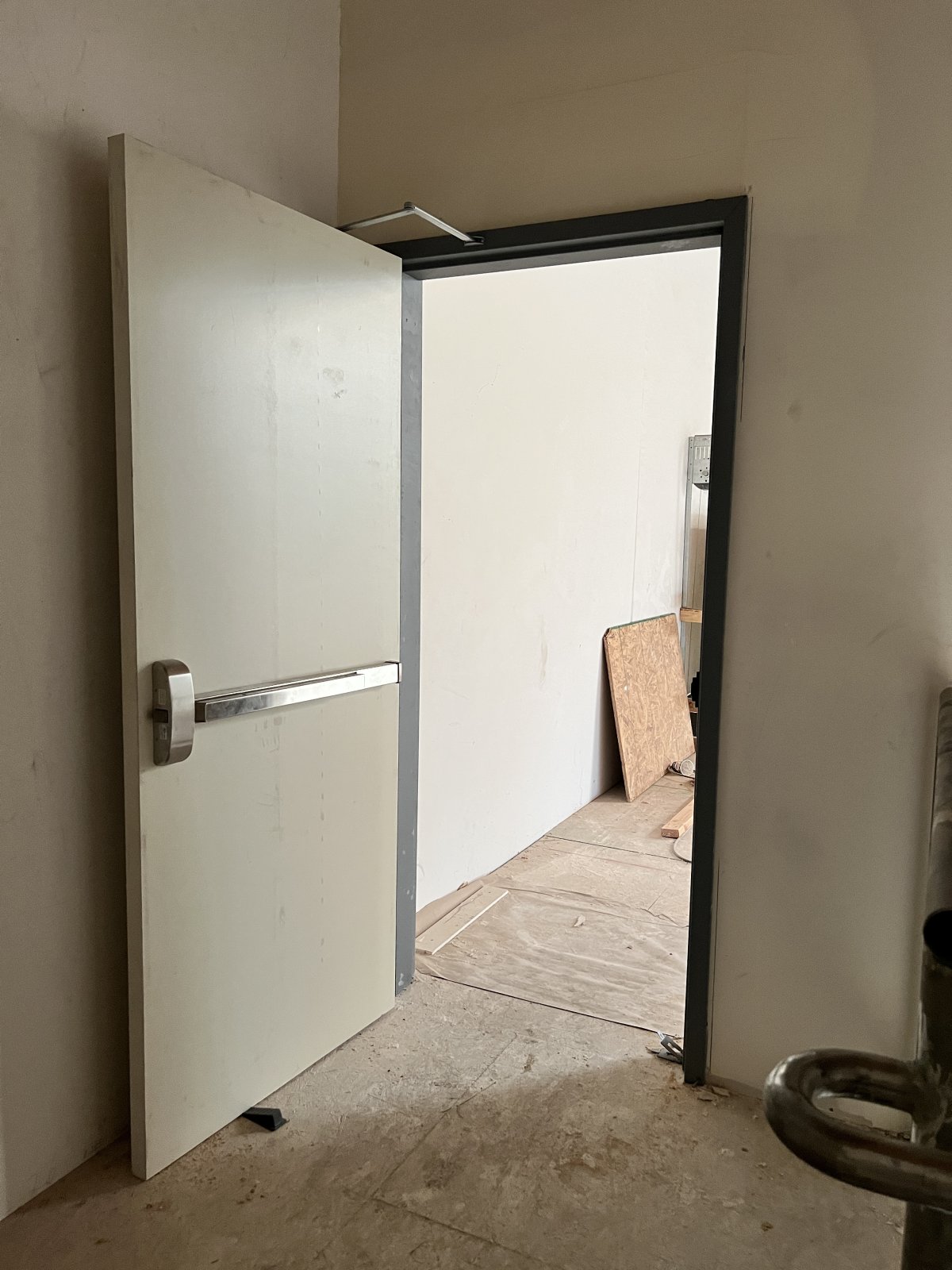
Confusion starts because most guides blend those hardware rules with door clearance and opening-force rules from a different section of the standard. Below, we separate what the ADA says about hardware from what it says about the door assembly.
Federal ADA Rules vs. Building Codes: Why the Distinction Matters
The ADA is a federal civil rights law. The International Building Code and ICC A117.1 are model codes adopted and amended by states and local jurisdictions.
A door can meet the ADA and still fail a local plan review, or pass local inspection and still draw an ADA complaint.
For the federal text itself, the 2010 ADA Standards for Accessible Design is the controlling source. Chapter 4 covers doors, and Section 404.2.7 covers hardware specifically. Read the original before you rely on a summary, including this one.
ADA Door Handle Requirements: Shapes, Gripping, and One-Handed Operation
ADA door handle requirements are simple: the handle must be operable with one hand, without tight grasping, pinching, or twisting of the wrist. Lever handles, ladder pulls, and U-shaped pulls satisfy this. Round knobs do not.
The shape determines the motion. A lever converts a downward push into latch release, manageable with an elbow or closed fist. A knob requires a rotational grip many users cannot produce.
Handles must also be mounted with clearance on the latch side. We offer engraved stainless pull plates and solid-bar pulls sized for this clearance.

Hardware Covered: Handles, Pulls, Latches, and Locks
The standard applies to every operable part of the door: handles, pulls, latches, locks, and other operating devices. If a person has to touch it to get through, it is covered.
That includes thumbturns on privacy locks, exit device touchpads, and the actuator on an automatic operator. It excludes the closer body itself, but includes the closer's effect on opening force.
A common mistake is treating the lock and handle as separate purchases. On a sliding door, the thumbturn is the operable part and needs the same one-handed, no-twisting treatment as a lever.
ADA Door Hardware Mounting Height: Measuring Above the Finished Floor
All operable parts must sit between 34 inches minimum and 48 inches maximum above the finished floor.
Measure from the finished floor, not the subfloor, threshold top, or rough opening. On a renovation, the finished floor may not exist when the frame goes in.
For a typical lever, the height is taken at the lever, not the rose. For a pull plate, measure at the gripping surface.
Where a closer is mounted on the pull side, check that the closer arm does not intrude into the clear space the user needs to reach the handle.
ADA Door Opening Force Requirements: What Five Pounds Means in Practice
Interior hinged doors without a closer must open with no more than five pounds of force, measured at the leading edge with the door at rest, whether pushing or pulling.
Exterior doors and interior doors with a closer get more latitude, but fire doors still have to latch, and that is where the conflict lives.
The fix is a closer with independent adjustment of closing speed and latching speed. Our 300PCOV- Series Barrier Free (Exterior) Adjustable Door Closer with Full Cover is factory tested to meet or exceed ANSI Standard A156.4 Grade 1, and the 300 PBFCOV variant is non-sized and fully adjustable from size 1 through 4 for barrier-free applications, covering doors from 30 to 185 pounds.
ANSI/BHMA A156.4 door control standard defines the grade and cycle testing for closers. Grade 1 is the heavy-duty classification, which matters in high-traffic buildings where a cheaper closer will lose its adjustment within a year.
Scope and Exceptions: Which Doors and Gates the Rules Apply To
The 2010 ADA Standards do not apply to every door in a building.
PULL1007ADA Engraved Stainless Steel Pull Plates (1" Round Pull Bar) →
The general rule: a door must comply if it is on an accessible route, or if another provision specifically requires it.
Doors that are typically covered:
- The building entrance and any entrance on an accessible route.
- Doors serving accessible spaces, including toilet rooms, parking structures, and tenant spaces.
- Doors along the accessible path between an entrance and an accessible space.
- Gates on an accessible route, which Section 404 treats as doors for hardware and force purposes.
Doors that may be exempt or partially exempt:
- Doors to small, non-accessible spaces. Section 206.1 Exception 1 allows an accessible route to be omitted where the only access is a controlled or locked entrance, or where the space is not required to be accessible. If the space is not required to be accessible, the door serving it is generally not on an accessible route.
- Closet and storage doors in residential units. These fall under the residential provisions, and applicability depends on whether the unit is covered by Title II or Title III and whether the space is on an accessible route. The exemption is narrow and tied to occupancy classification, not door type.
- Doors to elevator pits, mechanical rooms, and similar spaces. These are often exempt because the space itself is not required to be accessible, but the exemption applies to the space, not to door hardware as a category.
- Fire-rated assemblies. Section 404 does not override life-safety requirements. A fire door must still latch and resist fire spread, and hardware must satisfy both accessibility provisions and the assembly's listing requirements. Where the two conflict, the stricter requirement governs.
- Existing buildings. The ADA Standards apply to alterations and new construction. Section 202.3 governs alterations, and requirements for existing elements depend on whether the alteration is planned, whether the element is on an accessible route, and whether the cost of compliance is disproportionate. A door replaced as part of an alteration may trigger compliance even if the building was previously exempt.
Gates deserve their own note. Section 404.1 applies to gates, including those serving parking lots, dumpster enclosures, and pedestrian entries.
Sliding and folding doors. Section 404.1 includes sliding and folding doors in the definition of doors. Hardware requirements apply to the operable parts, on a sliding door, often the thumbturn or pull, not a lever; on a folding door, the handle or pull used to unfold the panels.

Automatic and power-assisted doors. Section 404.3 governs automatic and power-assisted doors.
Because model code adoption varies by state and edition, the only reliable answer for a specific project is the code the authority having jurisdiction has actually adopted.
ADA Door Hardware Checklist: A Field-Ready Compliance Guide
This checklist combines hardware requirements with the door assembly requirements they interact with, in the order you will encounter them on site. Each row cites the controlling section of the 2010 ADA Standards so you can verify against the source text.
| Check | What to Verify | Controlling Section | Why It Fails |
|---|---|---|---|
| Handle shape | Lever, pull, or U-shaped pull | 404.2.7 | Knobs require grasping and twisting |
| Operable parts height | 34 in. min. to 48 in. max. AFF | 404.2.7 | Measured from subfloor or threshold |
| One-handed operation | Works with a closed fist | 404.2.7 | Handle needs a pinching grip |
| No tight grasping | No rotational wrist motion | 404.2.7 | Round or recessed hardware |
| Operating force | 5 lb. max. for interior hinged doors | 404.2.9 | Closer over-adjusted for latching |
| Latch-side clearance | Handle does not hit wall or jamb | 404.2.7 | Frame depth not checked |
| Closer adjustment | Independent closing and latching valves | 404.2.9 | Single-valve closer cannot do both |
| Bottom clearance | Door swings clear of the finished floor | 404.2.4 | Floor build-up not accounted for |
| Clear opening width | 32 in. min. clear width | 404.2.3 | Stop or hinge reduces the opening |
| Maneuvering clearance | Pull-side and push-side clearances | 404.2.4 | Hardware projection intrudes into the clear space |
How to Measure and Test Hardware on Site
Bring four tools: a tape measure, a calibrated push-pull gauge, a level, and the manufacturer's template.
Step 1: Measure operable part height. For a lever, measure at the lever itself, not the rose.
Step 4: Verify clear opening width. Section 404.2.3 requires a 32-inch minimum clear width.
Step 5: Check maneuvering clearance. Section 404.2.4 addresses clear space on the pull and push sides of the door.
Common inspection mistakes:
- Measuring from the subfloor or threshold instead of the finished floor.
- Testing force by feel instead of with a calibrated gauge.
- Adjusting the closer to fix a latch problem without re-testing opening force.
- Assuming a local exception applies without checking the adopted code edition.
- Treating the lock and handle as separate purchases when both are operable parts.
For engraved pull plates and solid-bar pulls, verify projection against frame depth before installation.

Frequently Asked Questions
What are the requirements for ADA-compliant door knobs?
Round knobs generally do not meet ADA compliant door hardware requirements because they require tight grasping and twisting of the wrist to operate. The standards call for hardware that can be operated with one hand and without tight grasping, pinching, or twisting. Lever handles, ladder pulls, and U-shaped pulls are common compliant alternatives. If you are replacing knobs on a high-traffic door, a lever handle or pull plate is the safer choice.
What mounting height is required for accessible door hardware?
Operable parts on doors and gates must be mounted between 34 inches minimum and 48 inches maximum above the finished floor. This range applies to handles, pulls, latches, locks, and other operable hardware. Measure from the finished floor to the center of the gripping surface. For retrofits, check the existing height before ordering replacement hardware so you do not create a new compliance gap.
How much force should it take to operate an accessible door?
Interior doors without a closer must open with no more than five pounds of force. Doors with closers are limited to five pounds of force as well under the ADA Standards. Fire doors are the main exception because they must self-close and latch. Test with a calibrated force gauge at the latch side, pulling or pushing perpendicular to the door face. If the reading exceeds five pounds, adjust the closer or replace worn hardware.
Do ADA door hardware requirements apply to interior doors?
Yes, in covered buildings the requirements apply to interior doors along accessible routes, not just exterior entrances. That includes office doors, restroom doors, and doors between rooms in public accommodations. Some door types have exceptions, such as doors that are part of a patient care system or certain residential units. Check the scope section of the ADA Standards for your specific building type before assuming a door is exempt.
What is the required width for accessible doorways according to ADA compliance?
The clear opening width for an accessible door must be at least 32 inches measured between the face of the door and the stop, with the door open 90 degrees. This is a door and frame requirement, not a hardware one, but it affects hardware selection because thick pulls and plates can reduce the usable opening. Verify the clear width before installing new hardware, especially on retrofits where the frame is already set.
Are automatic door operators required by the ADA?
Automatic door operators are not universally required. The ADA Standards allow manual doors that meet the opening force and hardware requirements. Operators are typically used where doors are heavy, where traffic is high, or where users cannot reasonably operate a manual door. If you install an operator, the door must still meet safety and accessibility requirements, including signage and safe operation. Manual hardware that meets the five-pound limit is often the simpler path.