Table of Contents
- Choosing Stylish Door Hardware for Modern Homes
- Best Door Hardware Finishes for Modern Homes
- ADA Compliant Door Hardware Requirements You Should Know
- How to Install Modern Door Levers and Pulls
- Security and Smart Integration for Modern Door Hardware
- Sustainability and Material Durability in Door Hardware
- Conclusion
- Frequently Asked Questions
Last Updated: September 30, 2026
Choosing Stylish Door Hardware for Modern Homes
Stylish door hardware for modern homes combines lever or pull design, finish, and mechanical function to match a contemporary interior while standing up to daily use. At Cal Royal Hardware, we see the same pattern in nearly every renovation: homeowners spend weeks on tile and paint, then grab whatever lever is on the shelf, a decision that can cheapen a room fast.
Knob vs. Lever: Which Fits a Modern Interior
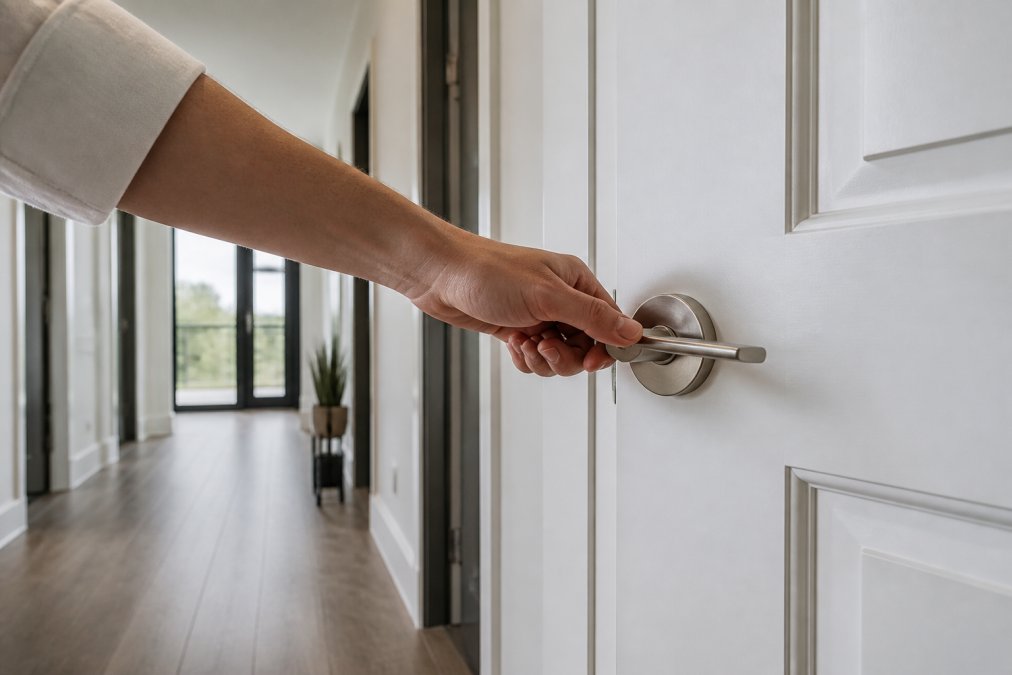
Levers win for modern interiors. A lever is a horizontal handle you push down to release the latch, and its straight or gently curved profile matches contemporary clean lines. Knobs require a twist and grip, which is harder for small hands, older adults, and anyone carrying groceries.
- Passage function: no lock, used for hallways and closets
- Privacy lock: a thumb-turn or push-button lock for bathrooms and bedrooms
- Dummy handle: no latch at all, used on the inactive side of a double door or a sliding panel
Best Door Hardware Finishes for Modern Homes
The best finishes for modern homes are satin nickel, matte black, and brushed brass, with satin stainless steel as the most durable everyday option. Finish is the fastest way to make mismatched hardware feel intentional.

| Finish | Best For | Durability | Care |
|---|---|---|---|
| Satin nickel | Kitchens, transitional rooms | High | Wipe with soft cloth |
| Matte black | Industrial, minimalist spaces | Medium-high | Avoid abrasive cleaners |
| Brushed brass | Warm, high-end interiors | Medium | Dry buff to reduce tarnish |
| Satin stainless steel | High-traffic areas, rentals | Very high | Mild soap and water |
Matching Finishes to Interior Design Styles
A cohesive design means picking one finish family and repeating it across doors, cabinets, and light fixtures. Mixing metals can work, but takes restraint.
ADA Compliant Door Hardware Requirements You Should Know
Most guides stop at "use a lever." That's the entry point, not the answer. If you're renovating for aging in place, accommodating limited grip strength, or bringing a rental up to accessibility standards, the handle is only one variable in a door assembly that has to work together.
What the Handle Alone Doesn't Fix
A compliant lever on a non-compliant door still fails. The most common culprits:
- Closers. A spring closer set too strong can push operating force past five pounds. Adjust the sweep and latch speed, or specify a low-opening-force closer.
- Thresholds. Anything over 1/2" at the door, beveled on both sides, is a common failure point. A 3/4" threshold is a trip hazard and a compliance problem.
- Clear floor space. A wheelchair user needs room to approach, pull, and maneuver. Pull-side and strike-side clearance both matter, and a door swinging into a tight corner can be unusable even with perfect hardware.
- Mounting height. Hardware on an accessible route typically needs to sit within a reachable range for a seated user. Measure from the finished floor, not the subfloor.
Aging-in-Place Upgrades That Pay Off
For homeowners planning to stay long-term, a few hardware choices do more than any single product:
- Swap every round knob on main-floor doors to a lever. Bedrooms, bathrooms, and the garage entry are the priorities.
- Choose a lever with a return-to-door design so a sleeve or bag doesn't catch on the handle end.
- Add a lever-style deadbolt thumb turn rather than a small keyed cylinder inside, so the door opens without fine motor control.
- Consider a push-button or keypad entry for the main door so no one manages a key in the dark or with arthritic hands.
For Multifamily and Commercial Properties
This isn't optional on covered projects. Property managers who skip it risk failed inspections and costly retrofits, and the fix is almost always cheaper at specification than after occupancy. Specify ADA-compliant levers, low-force closers, and compliant thresholds from the start. On an existing building, walk the accessible route first and note every door that fails on force, clearance, or height before ordering.
How to Install Modern Door Levers and Pulls
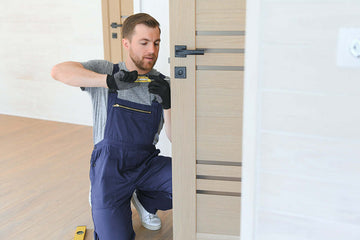
Installing a modern door lever takes about 20 to 30 minutes per door with basic tools, well within reach for a DIY homeowner.
What You'll Need:
- Phillips screwdriver
- Tape measure
- Chisel or utility knife for latch plate fitting
- New lever or pull set with mounting hardware
Security and Smart Integration for Modern Door Hardware
Security hardware has moved well past simple keyed entry. Today's options include keypad locks, deadbolts with hardened steel inserts, and connected locks that fit standard door prep without re-drilling. Design and technology now have to be answered together, because a smart lock that clashes with your finish palette undoes the rest of the room.
BDPUL6000 FLAT TYPE BARN DOOR PULL →
The Mechanical Foundation Still Matters
A deadbolt is still the core of residential security. Look for a full 1" throw with a hardened steel insert, which resists sawing and forced entry. Grade matters too: ANSI/BHMA Grade 1 is the top rating for durability and cycle testing, and the standard for rentals and commercial doors. A smart lock bolted to a Grade 3 deadbolt has a weak point behind it.
How Smart Locks Actually Connect
Connected locks fall into a few practical categories, and the differences matter more than the marketing:
- Keypad-only (standalone). No app, no network. You program codes at the lock. This is the most reliable option and the easiest retrofit because there's nothing to pair or power beyond batteries. The [CR8000 Digital Keypad Door Lock | calroyalhardware.com] fits this category, up to 100 user codes plus manager codes, ANSI/BHMA Grade 1 rated, fire-rated, and reversible for left- or right-hand doors.
- Bluetooth. App control within roughly 30 feet. Good for a single-family home where you're usually nearby. No hub required, but no remote access either.
- Wi-Fi. Connects directly to your network for remote control and notifications. Convenient, but Wi-Fi radios draw more battery, so expect more frequent battery changes than a Bluetooth or keypad-only lock.
- Z-Wave or Zigbee. These require a hub, a smart-home controller or compatible speaker, but integrate cleanly with broader home automation and are gentler on batteries than Wi-Fi.
- Matter and Thread. The newer interoperability standard lets locks work across ecosystems without a brand-specific hub. Adoption is still uneven, so verify compatibility with your existing setup before you buy.
Retrofit Compatibility: What to Check Before You Buy
Most connected deadbolts replace an existing deadbolt on standard door prep, so your bore hole and backset usually work. Still confirm:

- Door thickness. Most residential smart locks fit 1-3/8" to 1-3/4" doors. Thicker doors need a specific kit.
- Backset. 2-3/8" or 2-3/4" are standard; confirm yours matches.
- Handing. Some locks are reversible; others must be ordered left or right.
- Existing deadbolt size. If your current deadbolt has a non-standard faceplate, you may need an adapter or a new bore.
- Power. Battery life varies by radio type. A keypad-only lock can run a year or more on a set of batteries; a Wi-Fi lock may need attention every few months.
Matching Smart Hardware to a Modern Interior
Smart locks used to look like gadgets. The current generation is much closer to architectural hardware, and finish options have caught up. Satin nickel, matte black, and satin chrome are most common, pairing with the lever and pull finishes covered earlier. Mixing a smart deadbolt with a separate passage lever? Match the finish family so the two read as a set, not an afterthought.
| Product | Price | Grade | Best For |
|---|---|---|---|
| CB160 Deadbolt | $36.00 | Grade 1 | Budget-conscious security upgrades |
| ULT360 Deadbolt | $46.00 | Grade 1 | High-traffic residential and commercial |
| CR8000 Keypad Lock | $521.50 | Grade 1 | Multi-unit access control |
Sustainability and Material Durability in Door Hardware
The most sustainable hardware is the hardware you don't replace. Solid brass and stainless steel 304 outlast plated zinc and cheap alloys by years, resisting corrosion in humid rooms where lesser metals pit and flake.
Conclusion
The hardest part of upgrading door hardware isn't the install. It's resisting the first lever that looks good without checking whether it fits your door prep, finish palette, and security needs. Get those three right and the rest is a screwdriver and half an hour.
Frequently Asked Questions
What door handles are in style in 2026?
Matte black and satin nickel remain the two most requested finishes for modern homes, with brushed brass gaining ground in higher-end renovations. Lever handles in square and slim profiles outsell round knobs because they suit contemporary interiors and meet ADA requirements more easily. Flush pulls and barn door handles are also popular for sliding and pocket doors. The strongest trend is consistency: matching lever style, finish, and escutcheon across every interior door in the home.
How do I choose the right modern door hardware for a modern interior?
Start with the finish, then the function. Pick one finish family, such as matte black, satin nickel, or satin stainless steel, and repeat it on levers, deadbolts, hinges, and pulls. Match the handle profile to the room: slim square levers for minimalist spaces, hammered or rustic pulls for barn doors. Check door thickness (1-3/8" to 1-3/4" is standard) and backset before ordering so the latch fits existing door prep.
What are the ADA compliant door hardware requirements for residential doors?
The ADA Standards for Accessible Design require operable parts to be usable without tight grasping, pinching, or twisting of the wrist. Lever handles, push plates, and U-shaped pulls satisfy this; round knobs generally do not. Hardware should be mounted between 34 and 48 inches above the finished floor, and interior doors should open with no more than 5 pounds of force. Many Cal-Royal deadbolts, including the ULT360 and CB160, are listed as ADA compliant.
Are matte black door handles still in style?
Yes. Matte black has held its position for several years because it pairs with white shaker doors, natural wood, and industrial fixtures without looking dated. It hides fingerprints better than polished chrome and reads as a deliberate design choice rather than a default builder finish. The main caution is durability: cheaper black finishes can chip at the edges, so look for hardware with a stated corrosion-resistant or architectural-grade finish.