Table of Contents
- How to Tell Your Apartment Door Hardware Is Failing
- How to Replace a Door Knob Step by Step
- Sticking Apartment Door Lock Repair: Fix Before You Replace
- Tenant Permission to Change Door Locks: What Renters Need to Know
- Apartment Door Hardware Replacement Cost: Budgeting the Job
- Choosing Replacement Hardware That Fits Your Door
- Frequently Asked Questions
Last Updated: October 7, 2026
How to Tell Your Apartment Door Hardware Is Failing
Replacing failing apartment door hardware starts with knowing the warning signs. A wobbly knob or sticking door tells you something, catch it early and you avoid a lockout, security risk, or bigger repair bill.
Loose, Wobbly, or Broken Hardware
A knob that turns but does not feel solid is a failing lockset, the mounting screws have likely worked loose. Watch for a knob that moves when you push or pull it, stripped rosette screws, a lock cylinder that spins without engaging, or a latch that does not retract fully. Tightening the screws buys time, but once the metal is stripped, the lockset needs replacing.
Sticking, Jammed, or Hard-to-Operate Doors
A door that sticks is not always a lock problem, it can be a hinge, alignment, or humidity issue. Watch for a door that drags on the frame or floor, a latch that catches on the strike plate, having to lift or push the door to lock it, or a key that turns hard. These issues worsen with weather changes, so fix them before the door jams completely.
How to Replace a Door Knob Step by Step
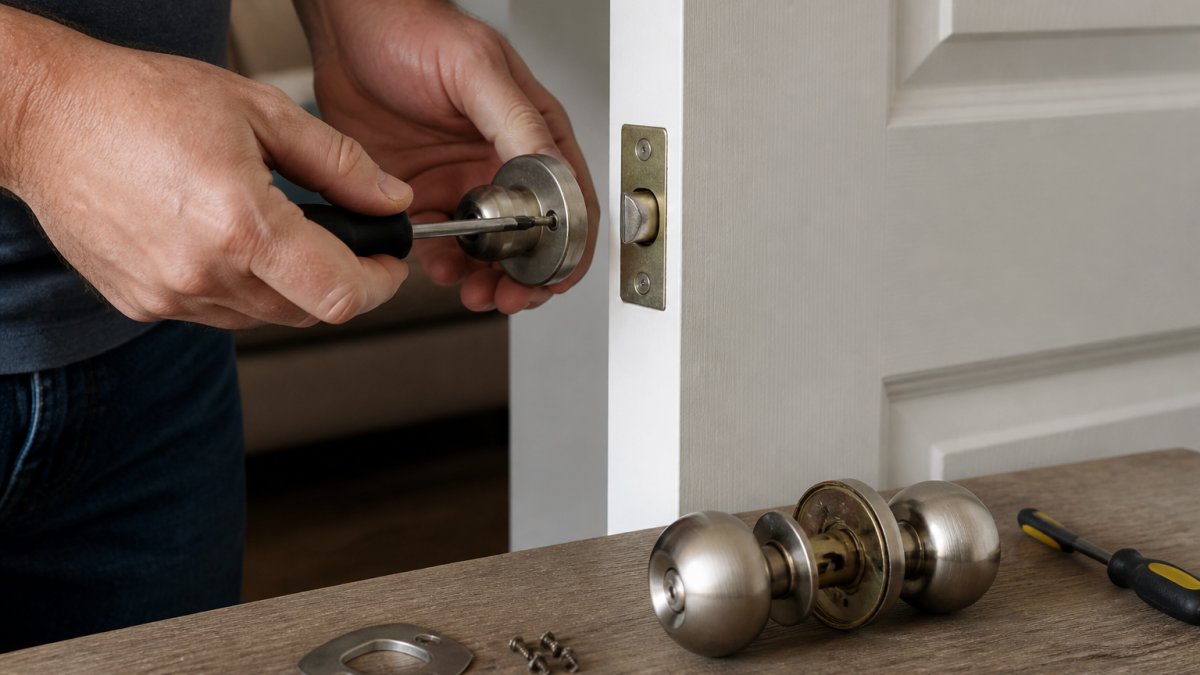
Replacing a doorknob is a job most homeowners can finish in under an hour. The steps below cover identification, removal, measurement, installation, and testing for a standard apartment door.
Step 1: Identify What You Have Before You Buy Anything
Apartment doors use a few lockset families, and they are not interchangeable:
- Cylindrical lockset, most common on apartment entry and interior doors. The lock body is a cylinder bored through the door face with a latch in the edge. Almost all builder-grade apartment knobs and levers are cylindrical.
- Mortise lockset, a rectangular box mortised into the door edge. Common on older buildings and some commercial-grade apartment entries. You cannot swap it for a cylindrical lock without patching and re-boring the door.
- Tubular / drive-in latch, a cylindrical variant where the latch presses into the edge bore instead of screwing to a faceplate. No visible latch faceplate screws means you likely have one.
Also note whether the door is keyed on one side only (entry) or non-keyed passage/privacy (bedroom, bathroom). Buying a keyed entry lockset for a bathroom door is a common, expensive mistake.
Step 2: Take Three Measurements
Write these down before you shop:
- Backset, the distance from the door edge to the center of the crossbore. Standard is 2-3/8 inches or 2-3/4 inches. Most residential doors are 2-3/8 inches; many commercial doors are 2-3/4 inches. A lockset built for one backset will not fit the other without an adapter or a new bore.
- Door thickness, most interior apartment doors are 1-3/8 inches; entry and commercial doors are commonly 1-3/4. Locksets come in thickness-specific kits, and the wrong one will not clamp.
- Bore size, the crossbore (big hole through the face) is usually 2-1/8 inches and the edge bore (small hole in the door edge) is usually 1 inch. If your door was drilled for an older or nonstandard lockset, confirm before buying.
Handing matters too. Stand outside the door: hinges on your left means left-hand; on your right, right-hand. Most cylindrical locksets are reversible.
Step 3: Tools You'll Need
Gather these before you start:
- Phillips-head screwdriver (a stubby one helps on tight rosettes)
- Flathead screwdriver or small pry tool
- Tape measure
Step 4: Remove the Old Knob and Prep the Door
- Remove the inside knob or rosette, on most cylindrical locksets the rosette twists off counterclockwise, or two mounting screws sit under a decorative cover.
- Pull both halves apart; the outside half frees once the through-bolts are removed.
- Remove the two latch screws on the door edge and slide the latch out.
- Clean the bore and edge hole, old paint, splinters, and dried lubricant cause new latches to bind.
- Check bore size and backset against your new lockset; if they match, install.
Step 5: Install the New Lockset
- Feed the latch into the edge bore with the bevel facing the frame, the angled side faces the direction the door closes.
- Screw the latch faceplate in, but do not overtighten; you can strip the wood or plate.
- Slide the outside half through the crossbore, keeping the key cylinder on the exterior side.
- Connect the inside half and start the through-bolts by hand.
- Tighten screws evenly, alternating sides, uneven tightening is the most common cause of a binding knob.
- Install the rosette or trim cover.
Step 6: Test Before You Close the Door
Test with the door open first, then closed:
- Turn the knob both directions and confirm the latch retracts fully.
- Lock and unlock the deadbolt or keyed function several times.
- Close the door and confirm the latch drops into the strike plate without lifting or pushing.
If the latch catches on the strike plate, adjust the strike plate before assuming the lockset is defective.
Step 7: Troubleshoot the Common Failures
- Latch will not reach the strike plate, the door has shifted or the strike plate is misaligned. Loosen the strike screws and nudge it toward the latch, or file the opening slightly.
- Knob binds or feels gritty, through-bolts are uneven or the latch is not seated. Loosen, reseat, and retighten evenly.
- Screws spin without tightening, the holes are stripped. Fill with a wooden matchstick or wood glue and a toothpick, let it cure, and re-drive. If the door is split, use a larger faceplate or repair plate.
If the door still will not close cleanly after these fixes, the problem is likely door alignment or hinge wear.
Sticking Apartment Door Lock Repair: Fix Before You Replace
Sticking apartment door lock repair is usually cheaper than replacement. Try these fixes first.
- Lubricate the latch and cylinder. Use a dry graphite or silicone spray, not oil. Oil collects dust and makes it worse.
- Tighten every screw. Loose hinges and strike plates cause most sticking doors.
- Adjust the strike plate. Loosen the screws and nudge it until the latch drops in cleanly.
If the lock cylinder itself is failing, repair will not help. That is when you replace.
Tenant Permission to Change Door Locks: What Renters Need to Know
Tenant permission to change door locks is not optional in most leases. Renters usually need written approval before swapping hardware, and many buildings require the landlord to retain a key or entry code for emergency access. Getting this wrong can cost your deposit or create a lease violation.
What Your Lease Probably Says
Most residential leases include an alteration clause and a lock-and-key clause. Read both before you touch the door.
- Alteration clause, governs whether you can modify the unit and whether changes must be reversed at move-out. Many leases allow "like-for-like" swaps (same style, finish, function) but prohibit upgrades or door alterations.
- Lock-and-key clause, governs who holds keys and landlord access. A common requirement is that the landlord retains a key or code for emergency entry, maintenance, and inspections.
- Entry-door restrictions, many leases treat the entry door differently from interior doors. You may swap a bedroom or bathroom knob freely but need written approval for the entry lockset.
If your lease is silent, do not assume you can change the lock. Send a written request and get a written answer.
Building and Fire-Safety Requirements
Apartment entry doors are often fire-rated assemblies, the door, frame, hinges, closer, and hardware form a rated system, and swapping a component can affect the rating.
- Self-closing and positive-latching, many apartment entry doors must self-close and positively latch. A lockset that does not latch reliably can violate fire-safety requirements.
- Exit requirements, egress doors must open freely from inside without a key, tool, or special knowledge. Never install a double-cylinder deadbolt (keyed both sides) on an apartment entry door; it is a life-safety hazard and prohibited in many jurisdictions.
- Building-wide keying, with a master key system, the property manager may need to re-key your unit to keep the master working. A lockset you install yourself may not accept the building's keyway.
If you are unsure whether your door is fire-rated, ask the property manager before you buy hardware. It is a one-question email that can save you a failed inspection.
How to Ask for Permission
A written request protects you if the landlord later disputes the change. Include:
- The reason (failing hardware, security concern, etc.).
- The exact hardware you plan to install (brand, model, function, finish).
- Confirmation you will provide a key or access code.
- A statement that you will restore the original hardware at move-out if requested.
- A request for written approval before you begin.
Keep a copy of the request and approval. If the landlord approves verbally, follow up with an email summarizing what was agreed.
Key Control and Move-Out
- Provide a key or code. If the landlord requires access, hand over a key or register the code before calling the job done.
- Do not change the keyway without telling the landlord. A new keyway can lock out maintenance and emergency responders.
- Keep the original hardware. Store the old lockset, latch, strike plate, and screws in a labeled bag for move-out restoration.
What Happens If You Skip Permission
Changing a lock without approval can be treated as an unauthorized alteration. Consequences vary by lease and state, but common outcomes include:
- A demand to restore the original hardware at your expense.
- A deduction from your security deposit.
- A lease violation notice, which can escalate.
Apartment Door Hardware Replacement Cost: Budgeting the Job
Apartment door hardware replacement cost depends on the hardware grade and who does the work. A basic residential lockset costs far less than a heavy-duty one.
Here is a simple breakdown:
| Option | Hardware Cost | Who Installs | Best For |
|---|---|---|---|
| Basic cylindrical lockset | Low | DIY | Standard interior doors |
| Grade 2 lockset | Mid | DIY or pro | Apartments, light commercial |
| Grade 1 lockset | Higher | Pro recommended | High-traffic or security doors |
| Full hardware swap (knob, latch, strike, hinges) | Highest | Pro | Aging doors, full upgrade |
Labor adds to the total if you hire a locksmith or handyman. Ask for a flat quote before work starts.
Our Pioneer SL Series Lockset is a Grade 2 option built for apartments and light commercial doors, with a lifetime warranty.
Choosing Replacement Hardware That Fits Your Door
Choosing the right replacement hardware comes down to three measurements. Get these wrong and nothing else matters.
- Backset: the distance from the door edge to the center of the bore. Standard is 2-3/8 or 2-3/4 inches.
- Door thickness: most interior doors are 1-3/8 inches. Commercial doors run 1-3/4 inches.
- Bore size: the crossbore and edge bore diameters must match the new lockset.
Match the finish to the rest of your home if looks matter. For durability, look for a Grade 1 or Grade 2 rating.
Cal Royal Hardware offers locksets for apartments, residential, and commercial doors, with fast shipping and durable finishes. Browse our store to find the right fit.
Frequently Asked Questions
Are you allowed to change door knobs in apartments?
It depends on your lease and your landlord. Most leases require written approval before you alter any apartment door hardware, and some specify that a licensed locksmith or maintenance tech must do the work. Ask your property manager first, and get the approval in writing. If you swap a knob without permission, you may be charged for restoring the original hardware at move-out.
How much does it cost to replace door hardware?
Costs split into two parts: the hardware itself and any labor. A Grade 1 cylindrical lockset like the Cal Royal Genesis CGN Series runs $115.00, while the Calypso CAL Series is $129.00 and the Pioneer SL Series is $65.00. Ball bearing hinges such as the BB31 run $6.37 each. If you hire a locksmith, expect to add a service call fee on top of the parts.
Can you replace an apartment door lock yourself?
Yes, if your lease allows it and the residential door has standard prep. Most cylindrical locksets need a 2-1/8 inch bore hole and either a 2-3/8 inch or 2-3/4 inch backset. Check those measurements before buying. The job usually takes 20 to 30 minutes with a Phillips screwdriver and a tape measure. If the door has a mortise lock or unusual prep, call a locksmith instead.
What should you do if an apartment door lock is sticking or jammed?
Start with the cheapest fix: tighten the hinge and strike plate screws, then apply a dry lubricant to the latch and cylinder. If the door still sticks, check alignment by looking at the gap around the frame. A strike plate that sits a few millimeters off can be filed or repositioned. If the lock cylinder itself is failing, that is a sign to replace the lockset rather than keep repairing it.
A failing lock is a security risk, not just an annoyance. Whether you repair or replace, the right hardware makes the job last.
Cal Royal Hardware builds heavy-duty locksets and hinges for apartments, homes, and commercial doors. Our Grade 1 and Grade 2 locksets are made for easy installation and long-term performance, with fast distribution and finishes that match your space.
Search our store to find the right hardware for your door.