Table of Contents
- Quick Comparison: Commercial Door Exit Devices by Price and Application
- Rim vs Vertical Rod Exit Devices: Which Configuration Fits Your Door?
- Fire-Rated Exit Devices and Code Compliance: NFPA 101 and IBC Checklist
- ADA Compliant Panic Bar Requirements: Opening Force, Height, and Trim
- How to Install Commercial Door Hardware: Door Prep, Stile Width, and Mounting
- Maintenance and Troubleshooting for Commercial Door Exit Devices
- Security vs Safety: Balancing Locking Control with Free Egress
- Conclusion: Choosing the Right Exit Device for Your Building
- Frequently Asked Questions
Last Updated: October 4, 2026
Quick Comparison: Commercial Door Exit Devices by Price and Application
If you need to buy commercial door exit devices, the fastest way to narrow the field is to match device type and price to the door you actually have. At calroyalhardware.com, we stock Grade 1 panic hardware that ships in 1-3 business days, so you are not waiting weeks on a special order.
An exit device is a door-mounted push bar assembly that lets occupants leave a building in a single motion without a key, while keeping the door locked from the outside. That single function is the reason life safety codes treat these devices differently from any other piece of door hardware.
Here is how our rim devices line up before you dig into configuration and code.
Model |
Price |
Type |
Best For |
|---|---|---|---|
$118.00 |
Rim |
Tight budgets, standard doors |
|
A2200 & AF2200 Series |
$133.00 |
Rim |
Retrofits, schools, offices |
A6600 Series |
$177.00 |
Rim |
Institutions, universities |
5000 x ENT00 |
$212.00 |
Rim with entry trim |
Exterior doors needing keyed entry |
A9800 & AF9800 Series |
$292.00 |
Rim |
High-traffic, ADA-critical exits |
A7700 & AF7700 Series |
$398.00 |
Rim |
Heavy institutional use |
$583.00 |
Vertical rod |
Double doors, no bottom latch |
|
MR9800 Mortise |
$603.00 |
Mortise |
Maximum security, hospitals |
9800 Alarm Panic |
$649.80 |
Vertical rod with alarm |
Restricted exits, monitored doors |
The rest of this guide explains which configuration fits your opening, what the fire and accessibility codes require, and how to keep the device working after it is installed.

Rim vs Vertical Rod Exit Devices: Which Configuration Fits Your Door?
The configuration question decides everything else, so answer it first. A rim exit device mounts on the face of the door and latches into a strike on the frame. A vertical rod exit device mounts the same way but drives rods to the top and bottom of the opening instead of a single side latch.
Rim devices are the workhorse. On a single door, or on a pair where one leaf is fixed, a rim device with a standard strike is the simplest and least expensive answer. Our A9800 and A2200 rim models use a 239 strike, while the A6600 and A7700 use a 938 strike, so confirm which strike your frame prep expects before ordering.

Vertical rods earn their keep on double doors that need top and bottom latching, particularly where a mullion is not practical. The trade-off is more moving parts, a handed device, and a taller installation footprint.
Fire-Rated Exit Devices and Code Compliance: NFPA 101 and IBC Checklist
Fire-rated openings change the rules, and getting this wrong is the most expensive mistake in the category. The NFPA 101 Life Safety Code governs means of egress, and the International Building Code sets the door and hardware requirements that local jurisdictions adopt and enforce.
The practical difference is the dogging feature. Dogging holds the push bar in the retracted position so the door swings freely, which is convenient in a busy lobby. On a fire-rated opening, dogging is prohibited on the fire exit hardware itself, which is why our fire-rated devices ship without the standard Allen-key dogging and include thru-bolts as standard packaging instead.
A code compliance checklist for any fire-rated exit:
- Device is UL listed for fire exit hardware, not just panic hardware
- Fire rating matches the door label, up to 3 hours on our F-series models
- Thru-bolts are installed, not just wood or machine screws
- No field-installed dogging on the fire device
- Door closer and coordinator function correctly with the new hardware
- Annual inspection is scheduled and documented
Our A9800 and AF9800 series carry an (A) label rating on pairs of doors up to 8'0" x 8'0" swinging in the same or opposite directions, and the F-series is UL listed for fire exit hardware for up to 3-hour labeled installations.
ADA Compliant Panic Bar Requirements: Opening Force, Height, and Trim
ADA compliant panic bar requirements come down to three measurable things: opening force, mounting height, and operable hardware. The ADA Standards for Accessible Design set the force limit, and our ADA-series devices are built to meet it.
Opening force is the number that fails most often. Our ADA models conform to ADA regulations with a 5-pound opening force, well under the limit the standards allow for interior doors.
Mounting height matters just as much. Push bars are installed so the actuating portion falls within the reach range the standards specify, and the bar should be operable across at least two-thirds of the door's clear opening width.
Trim selection is where accessibility and security collide. Lever and escutcheon trims on our devices are Grade 1 construction with a clutch on rose trims, which keeps the lever from being forced. Escutcheon trims are rigid and cover a 161 cutout, so they hide existing door prep rather than exposing it.
Requirement |
What It Means in Practice |
|---|---|
Opening force |
5 lbs on ADA models |
Operable width |
Two-thirds of clear opening |
Trim type |
Grade 1 lever or escutcheon |
Mounting height |
Within the standard reach range |
Latching |
Stainless steel latch bolt, 3/4" throw |
How to Install Commercial Door Hardware: Door Prep, Stile Width, and Mounting
Installation succeeds or fails on door prep, and that work happens before you touch a screwdriver. Verify stile width, door thickness, and backset against the template for your specific model, then confirm the strike prep matches what ships in the box.
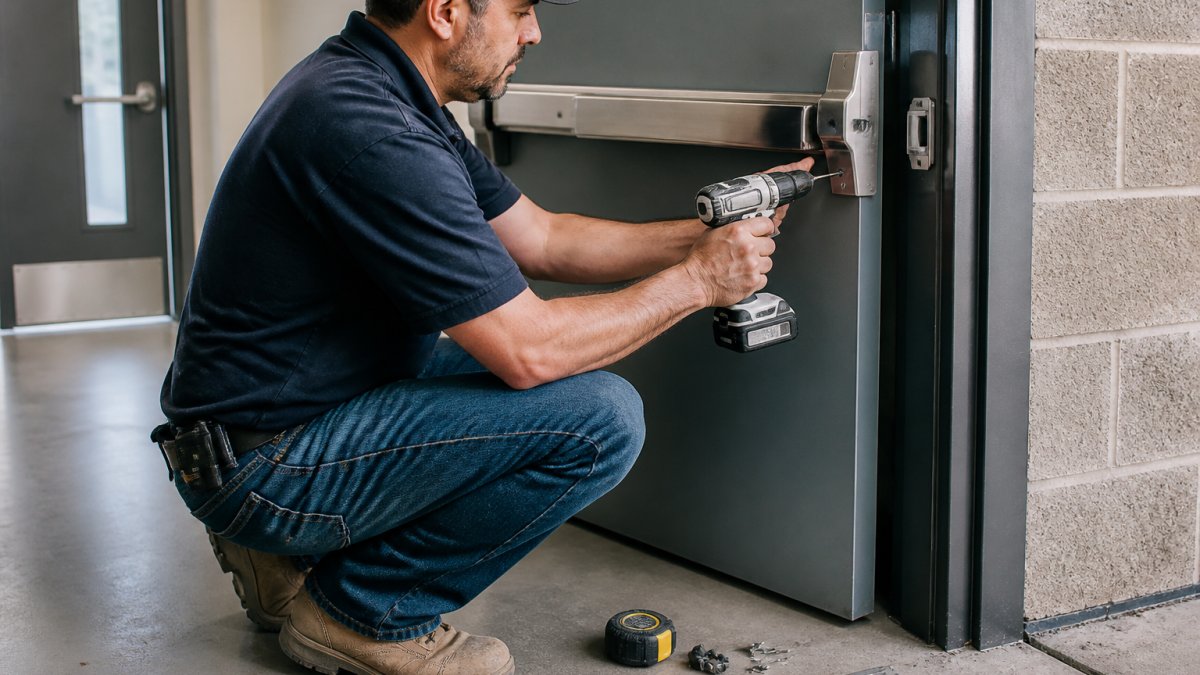
Most of our rim devices fit 1-3/4 inch thick doors as standard, with 2-1/4 inch thickness available as an option. Backset is 2-3/4 inches on the rim models. Minimum stile width runs 4-1/2 inches on the A-series rim devices and 3-3/4 inches on the 5000 series.
A9800 & AF9800 Series Rim Exit Device →
The sequence that keeps you out of trouble:
- Confirm door thickness, stile width, and backset against the template
- Mark and drill the chassis mounting holes using the supplied template
- Mount the chassis and check rail travel against the door swing
- Install the strike on the frame and verify latch engagement
- Attach the trim and test the lever or escutcheon for binding
- Cycle the device at least ten times before final tightening
Every device ships with wood and machine screws, and thru-bolts are included as standard packaging on fire-rated models. Templates and installation instructions for each series are available on the product pages, including handing conversion guides if you need to reverse the device in the field.
Maintenance and Troubleshooting for Commercial Door Exit Devices
Most exit device failures are not failures at all, they are alignment problems that show up as a bar that will not latch or a door that sticks.
Start with the simple checks. Does the latch bolt extend fully into the strike? Does the bar travel smoothly across its full stroke? Does the door close and latch without being lifted or pushed? If the answer to any of those is no, the fix is usually a strike adjustment or a hinge issue, not a new device.
Common problems and their fixes:
Symptom |
Likely Cause |
Fix |
|---|---|---|
Bar will not latch |
Strike misaligned |
Adjust strike position |
Stiff operation |
Frame binding or dry pivot |
Realign frame, lubricate pivot |
Door sags and drags |
Worn hinges |
Replace or tighten hinges |
Latch bolt sticks |
Debris in latch |
Clean latch cavity |
Device feels loose |
Loose thru-bolts |
Re-torque mounting hardware |
Keep stainless steel latch bolts and springs clean and dry. Our devices use stainless steel throughout the latch bolt and spring assemblies, which resists corrosion, but a buildup of grit will still cause sticking over time. A yearly inspection that includes cycling the device and checking fastener torque will extend its service life considerably.
Security vs Safety: Balancing Locking Control with Free Egress
Free egress and building security pull in opposite directions, and the exit device is where that tension gets resolved. The code is unambiguous: occupants must be able to leave without a key, a tool, or special knowledge. Everything else is a matter of how you control entry from the outside.
The solution is trim, not a modified bar. An exit device with entry trim, like our 5000 x ENT00, gives you a locking handle on the outside for authorized entry while keeping the push bar free on the inside. That is the correct way to secure an exterior egress door.
Alarmed devices solve a different problem. The 9800 Alarm Panic adds an alarm to the assembly, which deters unauthorized use of a restricted exit without restricting egress itself. For hospitals, schools, and institutional buildings where a specific door needs monitoring, that is the right tool.
Conclusion: Choosing the Right Exit Device for Your Building
The hardest part of buying commercial door exit devices is not the purchase, it is matching the device to the door, the code, and the way people actually use the opening. Get the configuration right, confirm the fire rating and ADA requirements, and the installation is straightforward.
calroyalhardware.com stocks Grade 1 exit devices across rim, vertical rod, and mortise configurations, all engineered for easy installation and long-lasting performance. Every device ships with mounting hardware, thru-bolts are standard on fire-rated models, and most orders leave our warehouse in 1-3 business days. Search our store to find the right device for your opening, or contact us if you need help matching a model to your door prep.

Frequently Asked Questions
What is the difference between a rim and mortise exit device?
A rim exit device mounts on the face of the door and uses a latch bolt that engages a strike plate on the frame. A mortise exit device installs inside a pocket cut into the door edge and includes a Grade 1 mortise lock for added security. Rim devices work on narrower stiles and are simpler to install, while mortise devices suit high-traffic institutional doors where locking control matters. Both meet ANSI A156.3 Grade 1 when specified correctly.
Are commercial panic bars required by ADA and NFPA 101?
Yes. ADA requires an opening force of 5 lbs or less on accessible egress doors, and NFPA 101 requires that exit doors be openable without a key, tool, or special knowledge. Cal Royal ADA-compliant exit devices meet the 5 lbs opening force requirement and are UL listed for panic hardware. Check your local building code for specific door-by-door requirements before you buy commercial door exit devices.
How do I measure a door for a new exit device?
Measure the door thickness (1-3/4 inch is standard), the stile width (the flat vertical edge of the door), and the door width. Cal Royal rim devices require a minimum 4-1/2 inch stile width, while the 5000 Series fits doors with a 3-3/4 inch minimum stile. Also confirm the backset (2-3/4 inch) and whether the door has a 161 cutout for the chassis. Wrong stile width is the most common reason a device will not fit.
What is the fire rating requirement for commercial exit devices?
Fire-rated doors require exit devices that are UL listed for Fire Exit Hardware. Cal Royal fire-rated models such as the AF9800, F6600, and F5000 Series are rated for up to 3-hour fire-labeled doors and carry UL10C and UBC 7-2-1997 listings. Non-fire-rated devices use dogging (holding the latch retracted), which is not permitted on fire doors. Always match the device rating to the door's fire label.
What are the most durable materials for commercial panic hardware?
Stainless steel and non-ferrous alloy chassis hold up best in high-traffic buildings. Cal Royal Grade 1 exit devices use stainless steel latch bolts with a 3/4 inch throw and stainless steel springs throughout. Finish options include US32D satin stainless steel, aluminum, and plated brass or bronze. US32D also accepts an anti-microbial coating for hospitals and schools where hygiene matters.