Table of Contents
- Why Easy to Install Commercial Door Locks Matter for Your Building
- Commercial Door Lock Installation: What to Know Before You Start
- Commercial Door Installation Tools You Will Need
- Top Easy to Install Commercial Door Locks
- Commercial Keyless Door Locks for Modern Access Control
- Choosing a Commercial Storeroom Lock: Key Considerations
- ADA Compliance and Fire-Rated Door Compatibility
- Maintenance and Troubleshooting for Long-Term Performance
- Frequently Asked Questions
Last Updated: October 9, 2026
Why Easy to Install Commercial Door Locks Matter for Your Building
Every door in a commercial building is a liability until it is properly secured.
A single failed lock can mean a tenant complaint, a security gap, or an emergency maintenance call.
This guide covers what makes a commercial lock easy to install, which models fit which doors, the tools you need, ADA and fire-rating requirements, and maintenance habits that keep locks working for years.
The five locksets and deadbolts below all install on standard door prep.
Commercial Door Lock Installation: What to Know Before You Start
Before you buy anything, measure your door. Commercial door lock installation succeeds or fails on three measurements: door thickness, backset, and bore diameter.
Backset is the distance from the door edge to the center of the bore hole.
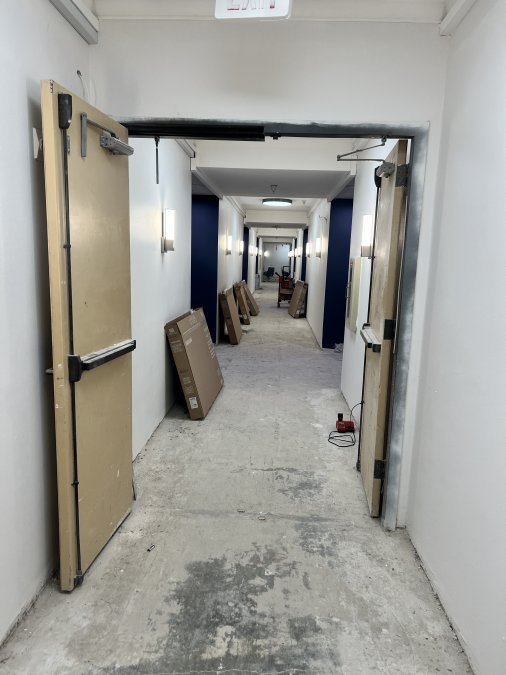
Door Compatibility: Wood vs. Metal Doors
Wood and hollow metal doors accept the same lock bodies but require different prep work. Wood doors are forgiving, you can chisel or drill a slightly off-center hole and fill it. Hollow metal doors are less tolerant: the lock body must align with the existing cutout, and the strike plate has to sit flush against the frame.
For metal doors, look for locks with adjustable faceplates and reversible latches. The Calypso CAL Series, for example, uses a latch faceplate adjustable for flat or beveled doors.

Understanding Security Ratings and Standards
Commercial locks carry a BHMA/ANSI grade that tells you how much abuse the lock survives. Grade 1 is the highest rating, tested to 800,000 cycles and verified for strength, torque, and finish durability.
Look for the ANSI/BHMA A156.2 Series 4000 designation on the spec sheet. That is the standard governing cylindrical locks, and it is the number your inspector or spec writer will ask about. BHMA standards for architectural hardware explains how the grading system works across lock types.
Commercial Door Installation Tools You Will Need
You do not need a locksmith's van. A standard kit covers almost every job:
- Tape measure for verifying backset and door thickness
- Power drill with a 2-1/8 inch hole saw and 1 inch spade bit
- Chisel for strike plate mortising on wood doors
- Phillips screwdriver or driver bit for thru-bolts
- Center punch for marking hole locations on metal doors
- File for cleaning up metal burrs after drilling
- Level for aligning the strike with the latch
If you are replacing an existing lock rather than drilling fresh, you may only need the screwdriver and tape measure. Standard door prep means the holes are already there.
Top Easy to Install Commercial Door Locks
We stock five locks that install on standard prep and ship fast. Here is how they compare, followed by a closer look at each.
| Model | Grade | Starting Price | Best For |
|---|---|---|---|
| Genesis CGN Series | Grade 1 | $115.00 | High-traffic commercial openings |
| Calypso CAL Series | Grade 1 | $129.00 | Extra-heavy-duty doors |
| SL Pioneer Series | Grade 2 | $65.00 | Budget-conscious projects |
| XP Explorer Series | Grade 2 | $74.95 | Mixed door thickness |
| CB160 Deadbolt | Grade 1 | $36.00 | Adding deadbolt security |
Cal-Royal Genesis CGN Series Lockset
The Genesis CGN Series is our top pick for most commercial openings.

The lever is non-handed, so it works on left- and right-opening doors without modification. Concealed mounting screws keep the finish clean, and the key-removable outside lever allows fast re-keying.
At $115, it is priced for facilities. The 6-pin solid brass C keyway accepts most common keyways, and interchangeable core options are available for BEST, FALCON, and ARROW systems.
Cal Royal Calypso CAL Series Lockset
Where the Genesis handles standard traffic, the Calypso CAL Series handles abuse. Also Grade 1, its extra-heavy-duty construction and wider door range (1-3/8 inch to 2 inches) suit institutional doors, hospital wings, and any opening with a heavier-than-standard door.
The latch faceplate adjusts for flat or beveled doors, which matters on hollow metal frames where a fraction of an inch throws off alignment. Backset options include 2-3/4 inch standard, plus 2-3/8 inch, 3-3/4 inch, and 5 inch for older buildings.
At $129, it is the most expensive lock here.
SL Pioneer Series Lockset
The SL Pioneer Series is the budget pick, and it does not feel like one.
What makes it easy to install is the optional thru-bolt configuration and the individual spring on each side of the lever.
If you are outfitting a building on a tight budget, this is the lock to buy in volume. It meets the same ANSI A156.2 Series 4000 standard as the Grade 1 models, just at a lower cycle rating.
XP Explorer Series Lockset
The XP Explorer Series sits between the Pioneer and the Genesis in price and capability.
The non-clutch mechanism is the main difference from the Genesis: a solid lever action rather than a free-turning clutch, which some maintenance teams prefer for its simpler internal design.
Choose this one when your building has a mix of standard and thick doors and you want a single SKU that covers both.
Cal-Royal CB160 Heavy Duty Deadbolt
A deadbolt is not a replacement for a lockset. It is an addition. The CB160 Heavy Duty Deadbolt is a Grade 1 deadbolt with a 1 inch throw and a hardened steel insert that resists sawing and forced entry.
At $36, it is a cost-effective way to add security to an entry door. Pair it with a cylindrical lockset on any exterior opening, and you get two independent locking points.
Commercial Keyless Door Locks for Modern Access Control
Keyless entry changes how you manage a building. Instead of cutting and tracking physical keys, you issue codes, revoke them when someone leaves, and audit who entered when.
The tradeoff is complexity: electronic locks need power, programming, and a plan for dead batteries. The good news is that most modern keypad locks install on the same standard door prep as a mechanical lock, so the swap is straightforward.
CR8000 Digital Keypad Door Lock
The CR8000 Series Digital Keypad Door Lock is our flagship electronic lock.
Installation is simpler than most people expect. The lock is non-handed and reversible, so it fits left- or right-opening doors without modification.
The clutch technology reduces internal wear by letting the lever turn without retracting the latch, the same principle behind the Genesis lockset. It operates from -30°F to 150°F, covering exterior doors in most climates.
Mechanical vs. Electronic Locks
Mechanical and electronic locks serve different jobs. A mechanical lock is a keyed cylinder requiring a physical key, no batteries, no programming, almost nothing to fail. An electronic lock uses a keypad, card reader, or credential reader and can be reprogrammed without rekeying.
| Feature | Mechanical Lock | Electronic Lock |
|---|---|---|
| Power required | No | Yes (battery or wired) |
| Rekeying | Replace cylinder or pins | Reprogram codes |
| Audit trail | None | Available on some models |
| Upfront cost | Lower | Higher |
| Best for | Low-turnover openings | High-turnover, multi-user access |
For a storage closet that two people use, mechanical wins. For a building with 40 tenants and rotating maintenance staff, electronic is worth the cost.
Choosing a Commercial Storeroom Lock: Key Considerations
A commercial storeroom lock is a keyed function where the outside lever is always locked and the inside lever is always free. It is standard for exterior doors on utility rooms, storage areas, and back-of-house openings, preventing entry without a key while still allowing exit at any time.
When you spec a storeroom lock, check four things:
- Function: Confirm the lock is storeroom, not entrance or classroom. The function determines which side is always locked.
- Grade: Grade 1 for high-traffic or exterior doors, Grade 2 for interior or low-traffic openings.
- Backset and thickness: Match the door's measurements to the lock's spec sheet before ordering.
- Keyway and core: Decide whether you need a standard C keyway or an interchangeable core for a master-key system.
The Genesis CGN and Calypso CAL both offer storeroom function with interchangeable core options, so you can standardize on a single key system across the whole building.
ADA Compliance and Fire-Rated Door Compatibility
Two regulations govern most commercial door hardware decisions and affect which lock you can legally install.
ADA compliance requires that door hardware be operable without tight grasping, pinching, or twisting of the wrist. The ADA Standards for Accessible Design set the specific requirements for door hardware, including operating force limits.
Fire-rated doors require hardware that has passed UL 10C testing. The SL Pioneer, XP Explorer, RL Pioneer, and CR8000 are all UL listed for 3-hour fire ratings and conform to UL10C and UBC7-2-1997.

Maintenance and Troubleshooting for Long-Term Performance
Commercial locks fail in predictable ways, and most failures trace back to three causes: loose thru-bolts, lever sag, and worn cylinders. A basic maintenance routine catches all three before they become emergency calls.
Every six months:
- Tighten all thru-bolts and mounting screws
- Test the latch and deadbolt for smooth operation
- Apply a dry lubricant to the cylinder and latch (never oil, which attracts dirt)
Every year:
- Inspect lever springs for sag
- Check the strike plate alignment
- Test all user codes on electronic locks and replace batteries
Common problems and fixes:
| Problem | Likely Cause | Fix |
|---|---|---|
| Lever droops | Worn or broken lever spring | Replace spring cage or lock |
| Key sticks | Dirty or worn cylinder | Clean and lubricate, or replace cylinder |
| Latch does not retract | Misaligned strike or loose thru-bolts | Re-align strike, tighten bolts |
| Keypad unresponsive | Dead batteries | Replace AA batteries or use 9V emergency port |
Locks with individual lever springs, like the Pioneer and Explorer series, resist sag longer than single-spring designs.
Securing a commercial building means choosing hardware that installs cleanly, meets code, and survives years of daily use. The wrong lock creates callbacks, inspection failures, and security gaps.
Frequently Asked Questions
What is the easiest commercial door lock to install?
Cylindrical locksets with pre-set backsets and non-handed levers are the easiest to install. The Cal-Royal Genesis CGN Series and Calypso CAL Series both feature non-handed levers and thru-bolt installation, which simplifies the process. Keypad locks like the CR8000 are also designed to fit standard door preparations and are reversible for left or right doors, making them a good choice for DIY installation.
Can I install a commercial door lock myself?
Yes, many commercial locks are designed for DIY installation. You will need basic tools like a screwdriver, drill, and chisel. However, if you are installing on a hollow metal door or need to modify the door preparation, it is best to hire a professional. Always check the installation instructions for your specific lock model, as some may require additional steps for fire-rated doors or ADA compliance.
What tools do I need to install a commercial door lock?
For most commercial door locks, you will need a tape measure, screwdriver set (Phillips and flathead), drill with bits, chisel, hammer, and a hole saw if you are creating new bores. A wrench may be needed for thru-bolt installation. Some locks come with templates to help with alignment. Always wear safety glasses and gloves during installation.
What is the difference between a Grade 1 and Grade 2 commercial lock?
Grade 1 locks are tested to 800,000 cycles and are the highest rating for commercial use, making them ideal for high-traffic areas like schools and hospitals. Grade 2 locks are tested to 400,000 cycles and are suitable for lighter commercial or residential use. Both meet ANSI/BHMA standards, but Grade 1 offers greater durability and security.
Do commercial door locks need to meet fire-door requirements?
Yes, if the door is fire-rated, the lock must be UL listed for fire doors. Many commercial locks, such as the Cal-Royal Pioneer SL Series and CR8000, are UL listed with a 3-hour fire rating. Always verify the fire rating of your door and choose a lock that meets the same rating to ensure safety and code compliance.