Table of Contents
- ADA-Compliant Door Hardware Requirements: What the 2026 Standards Actually Say
- ADA Door Handle Height Requirements and Reach Range
- ADA Door Hardware Operating Force: How Much Effort Is Too Much?
- Commercial ADA Door Levers vs. Round Knobs: Why Shape Matters
- Top ADA Compliant Door Handles for 2026: Product Comparison
- Installation and Retrofit Tips for ADA-Compliant Door Handles
- Frequently Asked Questions
Last Updated: October 5, 2026
ADA-Compliant Door Hardware Requirements: What the 2026 Standards Actually Say
If you are searching for the best ADA compliant door handles 2026 has to offer, compliance comes down to four measurable things: shape, height, reach, and force.
The full text of the standard is published by the U.S. Department of Justice ADA Standards for Accessible Design, and it is worth reading the door hardware sections directly rather than trusting a summary.
ADA-compliant door hardware requirements are the specific rules covering handle shape, mounting height, reach range, and opening force that let a person with limited grip strength operate a door independently.
A lever bolted at the wrong height is not compliant, no matter what the box says.
ADA Door Handle Height Requirements and Reach Range
The standard sets a clear band, but the band is not the whole test. Operable parts must sit between 34 and 48 inches above the finished floor, and the reach range is 15 to 48 inches for both forward and side approaches.
For most installations, we recommend centering levers at 36 inches. That height sits comfortably inside every reach band and matches what most users expect, so the door feels normal while still clearing the requirement.
Forward approach vs. side approach
A forward approach means the user faces the door squarely. The reach range runs 15 to 48 inches above the finished floor, and the handle needs unobstructed space in front of it so a wheelchair footrest or walker does not block it.
A side approach means the user approaches parallel to the door face, common in restrooms, closets, and tight corridors.
Clear floor space and maneuvering clearance
Height is only half the measurement. The standard also expects clear floor space at the door, commonly 30 by 48 inches at the pull side, with additional maneuvering clearance depending on swing direction. On a retrofit, adding a threshold, floor mat, or furniture in that zone can push a compliant handle out of range even when the mounting height never changed.
Two details trip people up on inspection:
- Handles on the pull side need clearance so hands and knuckles do not hit the frame
- The latch side needs enough room for a wheelchair user to approach and pull without repositioning
Measure from the finished floor, not the subfloor, on a retrofit adding threshold or tile, that difference can push a compliant handle out of range.
ADA Door Hardware Operating Force: How Much Effort Is Too Much?
Opening force is where a lot of "ADA compliant" doors quietly fail. Interior hinged doors without a closer must open with no more than 5 pounds of force; fire doors are capped at 15 pounds, measured at the latch.
Door closers are the usual culprit: a closer set too aggressively can push a door well past 5 pounds even when the handle is perfect. When retrofitting, adjust the closer sweep and latch speed before blaming the hardware.
Commercial ADA Door Levers vs. Round Knobs: Why Shape Matters
Round knobs are effectively dead in commercial accessibility. A knob requires a firm grasp and a wrist twist, both explicitly ruled out by the standard.
That is why every commercial ADA door lever we stock uses a return-to-door design: the lever curves back toward the door face so it cannot catch a sleeve, bag strap, or wheelchair armrest, and does not protrude far enough to be a hazard in a tight corridor.
Pull handles solve a different problem. On a push-side door with no latch, a straight pull or pull plate gives a large, easy target that works with a forearm or closed hand.
Top ADA Compliant Door Handles for 2026: Product Comparison
Below are the models we recommend most often, ranked by fit for common commercial and residential use cases. Every one meets the shape and operation requirements of the standard; the differences are durability, finish, and where they belong.
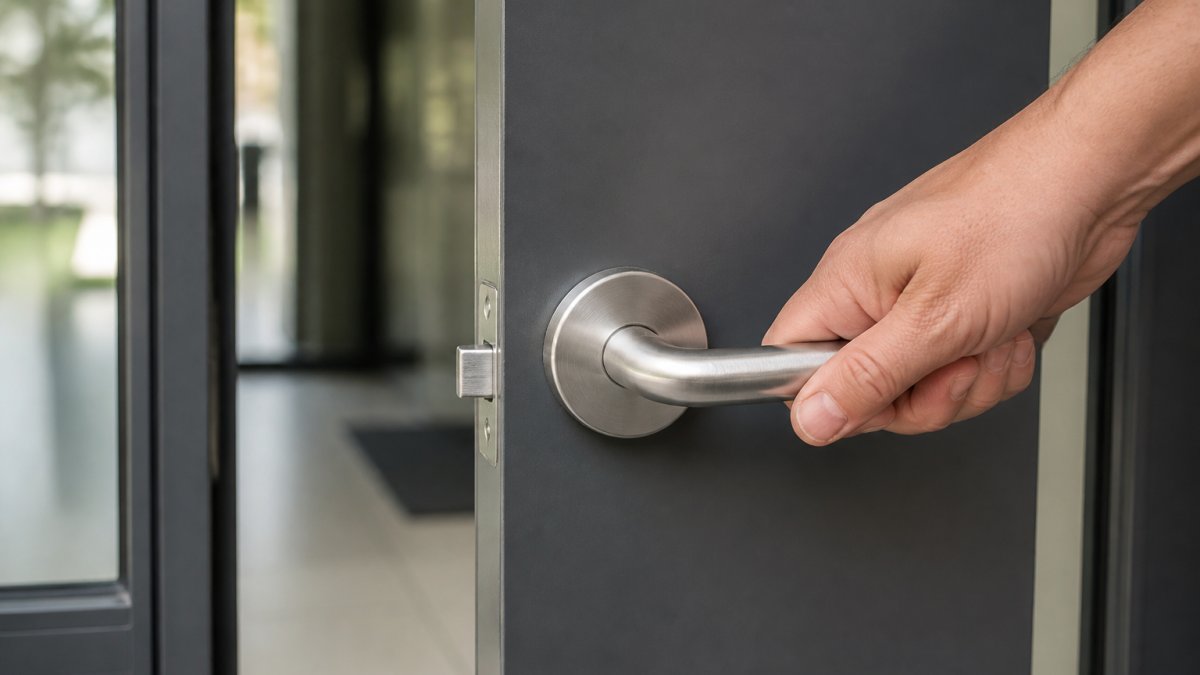
| Rank | Product | Price | Best For | Duty Rating | Standout Detail |
|---|---|---|---|---|---|
| 1 | Cal-Royal INDCGN Grade 1 Privacy Indicator Lock | $147.00 | Shared restrooms, healthcare | BHMA/ANSI Grade 1 | Red "IN USE" / Green "VACANT" indicator |
| 2 | Cal-Royal RL Pioneer Series Lock | $85.50 | Schools, offices, multifamily | BHMA/ANSI Grade 2 | 400,000-cycle rated, UL 3-hour fire |
| 3 | PULL1007ADA Engraved Stainless Steel Pull Plates | $91.66 | Push-side commercial doors | ANSI/BHMA A156.6 | Engraved "PULL," 1-7/8 inch clearance |
| 4 | HPUL Modern Hospital Double Pull Arm | $72.75 | Hospitals, clinics | ANSI/BHMA A156.6 | Microban anti-microbial coating |
| 5 | PULPL Aluminum Pull Plates | $24.40 | Budget retrofits | ANSI/BHMA A156.6 | One-piece mount, architectural finishes |
How we ranked them
We weighted four things: whether the hardware meets the shape and operation requirements of the standard, duty rating and cycle life, fit for a specific door type, and price-to-lifecycle value. A higher price did not automatically rank higher; the INDCGN sits at the top because it solves a problem the others do not.
1. Cal-Royal INDCGN Grade 1 Privacy Indicator Lock
Our top pick for any door where occupancy status matters. The INDCGN is a BHMA/ANSI Grade 1 privacy lever lock, the heaviest duty rating in the A156.2 Series 4000 standard.
It fits doors from 1-3/8 to 1-3/4 inches thick and ships with a 2-3/4 inch backset latch and 4-7/8 inch ASA strike.
Trade-off: the indicator adds a mechanical component that needs occasional cleaning in dusty environments, and the price puts it out of reach for a single residential door.
2. Cal-Royal RL Pioneer Series Lock
The workhorse of the lineup. The RL Pioneer is a Grade 2 cylindrical lever lockset tested to over 400,000 cycles, so it holds up in schools, offices, and apartment buildings where a light-duty lock would sag within a season.
PULL1007ADA Engraved Stainless Steel Pull Plates (1" Round Pull Bar) →
Flexible backsets (2-3/8, 2-3/4, 3-3/4, and 5 inches) make it a straightforward retrofit into existing prep. Clutch and non-clutch options match the security level to the door, and it accepts interchangeable cores.
Trade-off: Grade 2 rather than Grade 1, so a facility with extremely high abuse traffic may want to step up.
3. Cal-Royal PULL1007ADA Engraved Stainless Steel Pull Plates
For push-side doors that need a compliant pull and a clear instruction, this plate does both.

The kit includes six #6 x 1/2 inch stainless screws, two 1/4-20 x 2-1/2 inch steel screws, and two steel washers.
Trade-off: it is a pull-only solution, so it does not replace a latching lockset on a door that needs security. Pair it with a separate lock or use it on a door that only pushes.
4. Cal-Royal HPUL Modern Hospital Double Pull Arm
Built for clinical environments.
At 8-1/2 x 1 inches with a 5-1/4 inch center-to-center and a 3-3/4 inch projection, it gives a generous grip target for users with limited hand strength.
Trade-off: the 3-3/4 inch projection is generous for grip but can be a snag point in a tight corridor, so confirm clearance before specifying it on a narrow door.
5. Cal-Royal PULPL Aluminum Pull Plates
The budget option, and a good one. The PULPL is a one-piece mounted aluminum pull plate that conforms to ANSI/BHMA A156.6 and arrives packed with the pull handle, fasteners, and washers. Architectural finishes match existing trim.
At $24.40, this is the plate we suggest for a residential retrofit or low-traffic interior door where you want compliance.
Trade-off: aluminum is softer than stainless. For a high-traffic entrance, step up to the stainless PULL1007ADA.
Verification checklist before you buy
Use this list to confirm any handle on this page will actually work on your door:
- Mounting height: plan for a 36-inch center, measured from the finished floor, and confirm it lands inside the 34-48 inch band
- Reach range: check the approach direction (forward or side) and the clear floor space at the door
- Door thickness: confirm the door falls inside the hardware's stated range (for example, 1-3/8 to 1-3/4 inches)
- Backset: match the existing prep or confirm the hardware supports an adjustable backset
- Handing: verify left-hand, right-hand, or reversible before ordering
- Latch and strike: confirm the latch bolt and strike match the frame prep
- Lock function: decide between privacy, passage, and keyed entry before you buy
- Opening force: plan to measure at the latch with a gauge and adjust the closer last
Installation and Retrofit Tips for ADA-Compliant Door Handles
Retrofitting is usually simpler than people expect, but the measurements have to be right.
A few things we have learned from supporting contractors and DIY installers:
- Measure mounting height from the finished floor after any flooring change, not before
- On thru-bolt pulls, tighten evenly so the plate does not bow and create a pinch point
- Adjust door closers last, after the handle is installed, so you can confirm force at the latch
- Keep a force gauge on hand for commercial jobs; it is the only way to confirm the 5-pound interior limit
For sliding and pocket doors, a standard lever will not clear the frame. That is where an ADA thumbturn matters.
Compliance is not a checkbox you clear once. Doors get rehung, closers get tightened, and flooring gets replaced, and any of those can push a compliant door out of range.
Cal Royal Hardware stocks a full range of ADA-compliant levers, pull plates, and sliding door locks engineered for easy installation and long service life, with heavy-duty materials that hold their finish in high-traffic buildings.

Frequently Asked Questions
What are the ADA requirements for door handles in 2026?
ADA Standards require door handles to be operable with one hand and without tight grasping, pinching, or wrist twisting. Lever handles, pull plates, and push/pull mechanisms meet this. Round knobs do not. Handles must be mounted between 34 and 48 inches above the floor, and interior doors cannot require more than 5 pounds of force to open. These requirements apply to all accessible routes in commercial and public buildings.
How much force should it take to operate an ADA-compliant door handle?
Interior doors must open with no more than 5 pounds of force. Fire doors are the exception and may require more. For exterior doors, the limit is also 5 pounds unless the door is a fire door. Hardware operating force includes the force needed to turn the lever, push the thumbturn, or release the latch. Cal-Royal's ADA-compliant lever sets are designed to keep operating force low across their full cycle life.
Are lever handles required for ADA compliance?
Lever handles are not the only option, but they are the most common way to meet ADA operable-parts requirements. Pull plates, push bars, and other hardware that can be operated with a closed fist or without tight grasping also comply. Round knobs do not. When choosing commercial ADA door levers, look for models tested to ANSI/BHMA standards and marked ADA compliant by the manufacturer.
What is the most reliable door handle brand for ADA compliance?
Reliability comes down to testing and certification. Look for hardware that meets ANSI/BHMA A156.2 for locksets or A156.6 for pulls, carries an ADA-compliant label, and offers a warranty that covers commercial use. Cal-Royal Hardware offers Grade 1 and Grade 2 options with limited lifetime warranties on select models, which gives facility managers a clear path to long-term performance without constant replacements.
Can I install ADA-compliant door handles myself, or do I need a contractor?
Most lever sets and pull plates are designed for straightforward installation with basic tools. Cal-Royal's pull plates come with fasteners and washers, and lever sets include templates and instructions. If you are replacing an existing handle, check the backset and door thickness first. For new construction or fire-rated doors, a licensed contractor or locksmith should handle installation to keep the door's rating intact.